20/02/2025 Papers

From silk road to yield road: China’s investment strategies in a low-return environment

Overview

Chinese banks were supposed to be dead money. Instead, they have quietly become some of the most resilient income plays in a battered market. While many investors have avoided them due to concerns over state control and asset quality, their ability to generate strong dividends amid economic uncertainty has made them an unlikely haven.

Current Challenges

China’s economy has been battling multiple headwinds: a deepening property crisis, deflationary pressures, and weak domestic demand. In response, Beijing has rolled out a series of stimulus measures since the pandemic, hoping to reignite growth. Despite these efforts, the blue-chip CSI 300 Index remained stuck in a prolonged bear market, falling over 20% since 2020.

Last autumn, authorities unveiled some of their most aggressive interventions to date. The reserve requirement ratio (RRR) and the seven-day reverse repurchase rate were slashed, while the minimum down payment for second-home purchases was lowered. This initially triggered an intense—but short-lived—rally, as domestic investors briefly regained confidence in the government’s ability to boost demand.

Fast forward four months and market enthusiasm has fizzled. Fresh policy updates have failed to extend the rally, leading some investors to recall the déjà vu of 2022, when a major stimulus package initially lifted stocks, only for the market to drop 14% over the next six months. Today, deflationary fears and sluggish growth have pushed China’s 10-year bond yields to decade lows below 2%. Even multiple rate cuts from the People’s Bank of China (PBOC) have done little to lift equities. With property prices eroding consumer wealth, domestic investors now face fewer options for generating returns.
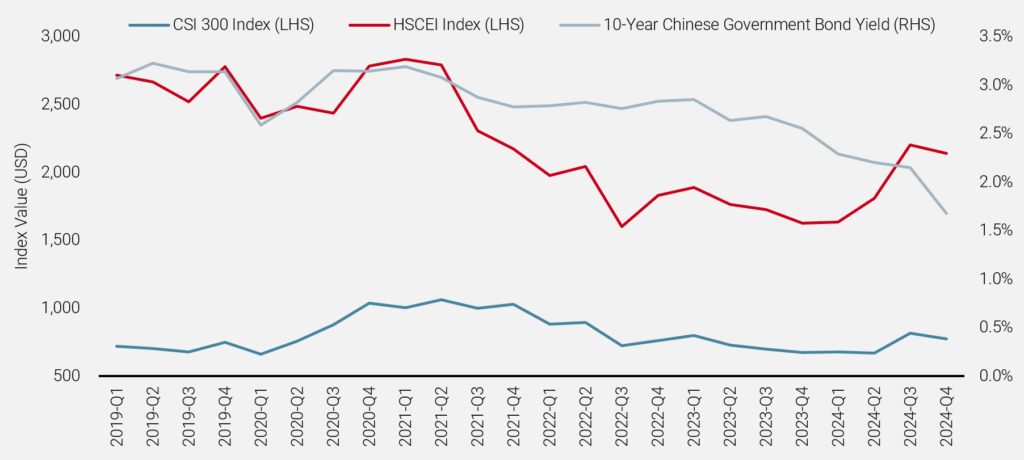
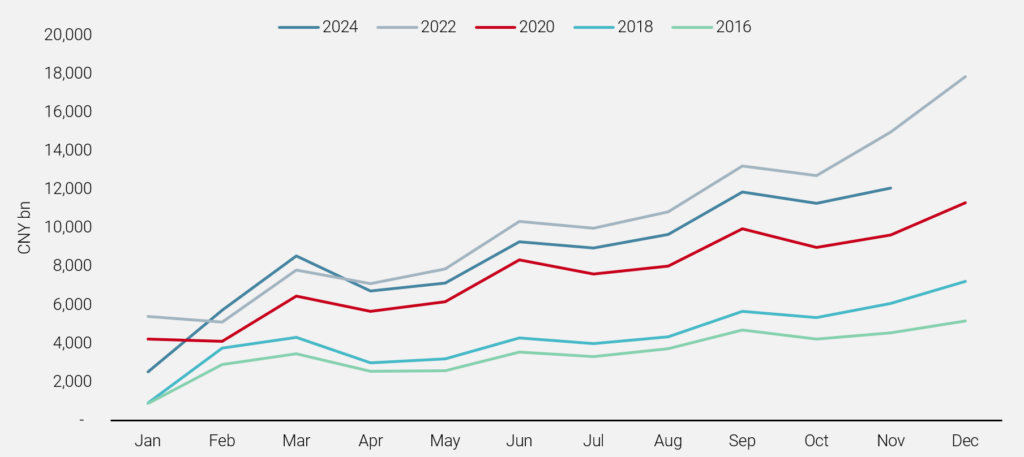
Figure 1: China’s Low Return Environment

Source: Bloomberg

The Savings Paradox

With growing concerns about job security and income, Chinese consumers have become more risk-averse. The share of individuals willing to make more investments plunged to below 15% in 2024, down from 26% at the end of 20191. Despite multiple interest rate cuts – typically a catalyst for higher spending – household savings have surged over the past five years.

China’s gross domestic savings stood at 44% of GDP in 2023, significantly higher than the G-7 average of 22%2. New retail deposits have ballooned, rising from CNY 3-4 trn between 2016 and 2018 to CNY 8-11 trn between 2022 and 20243. Capital controls limit access to offshore high-yield investments, keeping domestic money trapped within China’s financial system.

With limited investment alternatives, where has all this money been going?

Figure 2: Chinese New Retail Deposits

Source: Citi Research

The Unusual Suspects

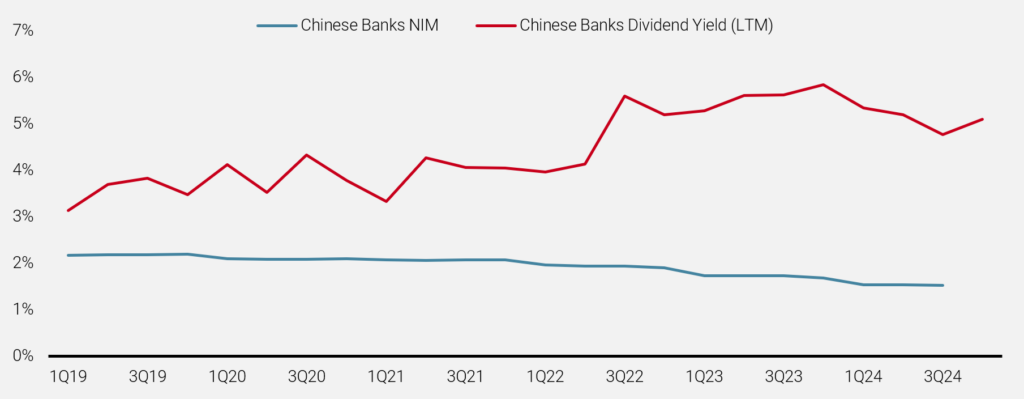
Despite scepticism from offshore investors – who cite concerns over government intervention and asset quality – Chinese banks have delivered some of the strongest returns post-pandemic. Even amid net interest margin (NIM) compression and a challenging economic backdrop, their mid-to-high single-digit dividend yields have been a magnet for local investors.

Unlike the struggling real estate and tech sectors, banks offer better stability, state backing, and reliable payouts. These factors have boosted their appeal in the current market environment. Last year, the government pledged to strengthen large banks’ capital buffers, reducing risks tied to non-performing loans. The result? Chinese banks A-shares have outperformed the broader index by 3.5% on average over the past eight quarters4.

In absolute terms, the banks’ total shareholder returns (TSR), including dividends, have been substantial. For example, the Agricultural Bank of China has delivered a 106% TSR, while the Bank of Shanghai has returned 82% over the same period4.

Figure 3: Chinese Banks: Net Interest Margins vs. Dividend Yields

Source: Unigestion, Citi Research

The Power of ‘Mind and Machine’

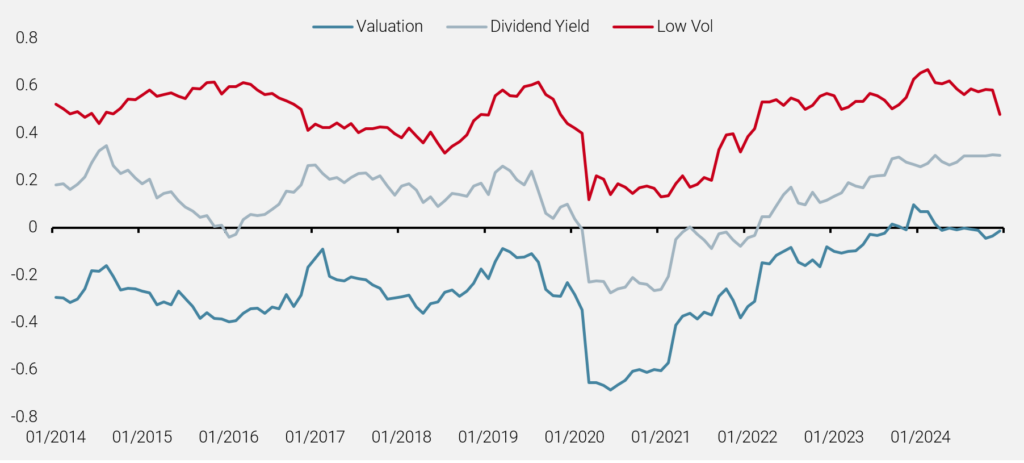
Our quant models have ensured we have not been on the back foot as this trend has emerged since 2014.

Despite widespread caution around potential policy-driven risks for Chinese state-owned banks, our models took a different approach, cutting through offshore investor scepticism and aligning more closely with mainland investors’ perspectives.

The model tactically identified an opportunity by assessing the shifting appeal of factors like dividend yield as well as low volatility over time and reflected this view in our emerging market portfolioAt this particular moment, the historically wide yield spreads of Chinese banks relative to the risk-free rate, coupled with government support amid broader economic challenges, presented a compelling opportunity for us to capitalize on.

Figure 4: Defensive Alpha Factor Bets in Emerging Markets

Source: Unigestion

1 People’s Bank of China (PBOC), Urban Depositor Survey Reports (2024, 2019). Available at: http://www.pbc.gov.cn/en/3688247/3688981/3709408/3946233/index.html
2 World Bank – https://data.worldbank.org/indicator/NY.GDS.TOTL.ZS?locations=CN
3 Citi Research, (2024 Data Through November Only).
4 Total Shareholder Returns, 1Q23–4Q24.